
Why Quoting Software Fails Mid-Market Sales Teams
Generic CRM and CPQ tools capture pieces of a quoting workflow. When the process is more connected than the software understands, the gaps become revenue risk.
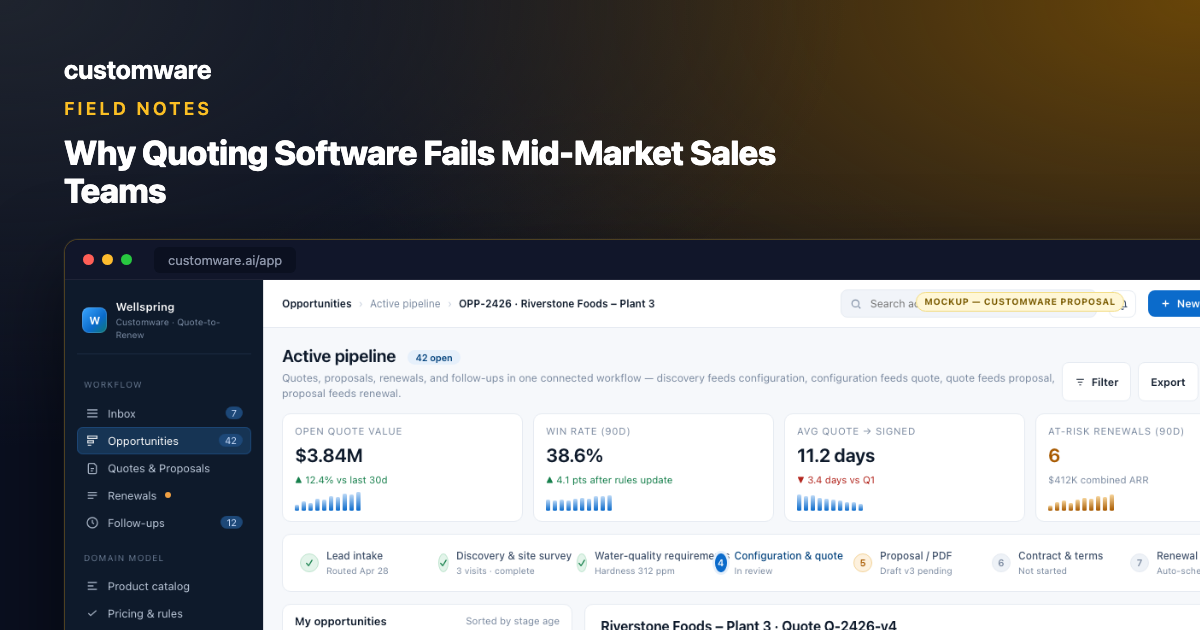
Generic CRM and CPQ tools capture pieces of a quoting workflow. When the process is more connected than the software understands, the gaps become revenue risk.
Most quoting software fails in the same place. Not the quote — everything the quote depends on.
A sales leader at a mid-market water treatment company owned a workflow that ran from lead intake and site-survey notes through water-quality requirements, product configuration, pricing, proposal generation, contract terms, renewal tracking, annual increases, and follow-up management. The quote at the end of that chain was the easy part. Keeping the whole chain connected, reliable, and trusted by the sales team was the hard part — and no single tool understood the whole thing.
The Quote Is Never Just a Document
"The quote was not an isolated document — it was the OUTPUT of a larger business process."
That sentence is the root of most quoting software failures. A quote that passes a visual inspection can still be wrong if discovery notes didn't feed the product recommendations, if the wrong service tier was assumed, or if a customer-specific exception was known to one salesperson but not captured anywhere. The output looks fine. The upstream logic wasn't trustworthy.
In a connected workflow, every stage feeds the next. Discovery feeds configuration. Configuration feeds pricing. Pricing feeds the proposal. The proposal feeds the contract. The contract feeds the renewal. Break any link — or leave any link implicit — and the whole chain becomes fragile. Change the renewal terms and nothing downstream updates automatically. Update the pricing matrix and the in-progress quotes don't know. The system holds data; it doesn't hold the business logic.
Where Generic CRM and CPQ Tools Hit the Ceiling
Generic tools are built for the median workflow. They handle pipeline stages, generate PDFs, and track renewals. What they can't do is model the specific way a particular business sells.
The Prototype Trap
Most mid-market software projects stall in a recognizable place: a prototype that works well enough to build hope, but not well enough to build trust.
The prototype reveals what the business wants. It doesn't solve what the business needs.
Adoption Is the Real Test
A system the sales team avoids is worse than no system. It creates invisible gaps — the workflow appears digital to management, but the real work has migrated back to email, spreadsheets, and tribal knowledge. You get false confidence at the top and quiet workarounds on the ground.
The trust criteria for a quoting workflow are concrete:
- Quotes are based on the right information from discovery — not what the last rep assumed
- Proposals reflect the actual customer situation, including exceptions and edge cases
- Follow-ups don't fall through the cracks when a rep is stretched thin
- Renewal terms are visible and tracked, not held by whoever set up the original contract
- Changes to pricing, service terms, or product logic propagate correctly without breaking in-progress quotes
What a Different Approach Looks Like
The answer isn't more point-tool configuration or another middleware layer stitching together CRM, CPQ, PDF generation, and a renewal spreadsheet. Stitching recreates the fragility by design — every integration is another place the chain can break, and none of them know about each other.
What works is a unified business layer that captures how the organization actually sells — the exceptions, the domain rules, the customer-specific logic that currently lives in experienced people's heads — and turns it into software a non-technical stakeholder can guide and change over time.
This is different from hiring a development agency that builds and hands over a black box. It's also different from a no-code tool that gives a business user control without production-grade reliability. The right model gives the sales stakeholder real agency over the build — directing the business logic, not just the screens — while producing a system the sales team trusts because the workflow is genuinely encoded, not approximated.
Whether you're productionizing an existing prototype or starting from the workflow up, the first durable asset isn't code. It's a structured understanding of how the business actually works — and software built on top of that rather than hoping it'll be inferred later.
If your quoting workflow is more connected than your current tools understand — or you're sitting on a prototype that revealed the gap but didn't close it — book a 30-minute build-vs-buy conversation. We'll tell you honestly whether this is a configuration problem, a tool problem, or a workflow-model problem.
Ready to fix this in your business?
Customware lets your team build production-grade software around how you actually work — by directing AI agents, not hiring a dev team or a long consulting engagement. Request early access.