
Why Your AI Workflow Keeps Breaking — And What to Build Instead
LLM automations break when vendors update models and your business logic drifts. Here's the architectural fix — and where AI still belongs in the stack.
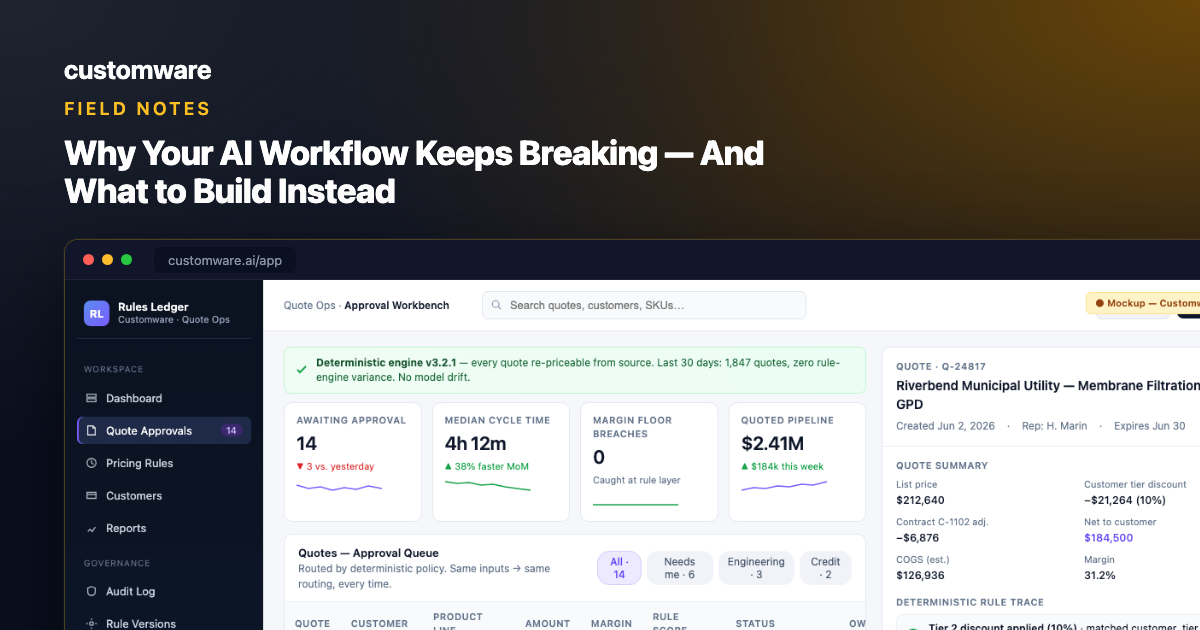
LLM automations break when vendors update models and your business logic drifts. Here's the architectural fix — and where AI still belongs in the stack.
"Small updates silently break entire chains of logic. It's like building on quicksand." That's not a skeptic who never tried AI automation. It's a practitioner who spent years building GPT-powered tools for clients — and watched them break.
If you've shipped a Copilot integration, a GPT-based approval workflow, or any LLM automation you've had to babysit, patch, or quietly retire — you already know the shape of the problem. The question is what to build instead.
The Real Problem Isn't the Model — It's the Architecture
When LLM-based workflows fail, they usually fail in one of three ways: the model drifted ("GPT-4.1 workflows that ran perfectly are now useless on GPT-5"), the output is non-deterministic (same input, different answer, different day), or the whole chain quietly degraded and nobody noticed until something downstream broke.
These aren't bugs to patch. They're structural properties of probabilistic systems. Large language models are designed to be flexible, generative, and context-sensitive — exactly the opposite of what a business workflow requires. Workflows need same input → same output, every time. That's not what LLMs do.
The fix that doesn't work: more layers. More prompt engineering, guardrails, retries, validators, fallback agents. As one practitioner put it, "The time and money that go into 'guardrailing,' 'safety layers,' and 'compliance' dwarfs just paying a human to do the work correctly." He's right about the problem. The answer isn't to abandon automation — it's to stop using the wrong tool for the load-bearing logic.
What You Can't Version-Lock
Here's the root issue in one sentence: you can't version-lock intelligence that doesn't understand what it's doing.
OpenAI, Microsoft, Google — they iterate on their models continuously. Your Copilot workflow from Q4 is not the same Copilot workflow today. The model changed. Your business rules didn't. The gap is now your problem, and your liability.
This matters most in exactly the places where it matters most: pricing approvals, compliance checks, customer-facing outputs, financial calculations. These are the workflows where "it gave a different answer this time" is a business incident, not a quirk. And they're the workflows where the appeal of AI automation is strongest — and the failure is most expensive.
Domain Rules Belong in Code, Not Model Weights
The fix is architectural, not tactical. It's not about finding a better model or writing tighter prompts.
Your business logic — pricing tiers, approval thresholds, compliance rules, handoff conditions — doesn't belong inside a model that nobody controls and nobody can audit. Those rules belong in software you own. Code that says: if condition X, then outcome Y. Every time. Versioned, testable, auditable, and completely indifferent to what any vendor shipped last week.
This is what Customware is built for. The platform lets non-technical operators encode domain rules into a purpose-built application — stable database, production-grade backend logic, proper web client — without needing a development team. The AI assists in building the system; it's not the system. Once it's built, it runs on your rules, not a vendor's weights.
For mid-market operations with specific, repeatable processes — quoting, field approvals, compliance workflows, data handoffs — this is the direct swap for the LLM automation that keeps misfiring. Faster than working with consultants, and without the ongoing cost of a team maintaining something fragile.
Where LLMs Still Belong in the Stack
This isn't an argument to rip out every LLM integration. It's an argument about placement.
There are things LLMs are genuinely good at: parsing unstructured text, interpreting free-form inputs, extracting structured fields from messy documents. If your workflow starts with customer emails, handwritten field notes, or inconsistently formatted PDFs — a narrow LLM layer at that intake boundary is legitimate.
The design principle: LLM at the boundary, rules engine at the core.
- Customer email arrives → LLM extracts product, quantity, delivery location
- Structured data hits your application → your code determines price, lead time, approval path
- The decision is deterministic, auditable, and consistent
The LLM handles translation from human-unstructured to machine-structured. Your application handles everything that matters for the business outcome. That's a defensible architecture. What isn't defensible is letting the model make the call — and then discovering six months later that the model changed and so did all your outputs.
If you've burned time or budget on an LLM automation that drifted, broke, or needed constant babysitting, book a 30-minute build-vs-buy conversation at customware.ai. We'll look at what you're actually trying to automate and tell you honestly whether a purpose-built application is the right call — and what building it would take.
Ready to fix this in your business?
Customware lets your team build production-grade software around how you actually work — by directing AI agents, not hiring a dev team or a long consulting engagement. Request early access.