
stage-gate
Why Quoting and Approval Rules Break When They Live in Spreadsheets
Quoting guardrails trapped in spreadsheets create risk you can't audit. Here's what a trusted, IT-approved stage-gate system looks like for manufacturers.
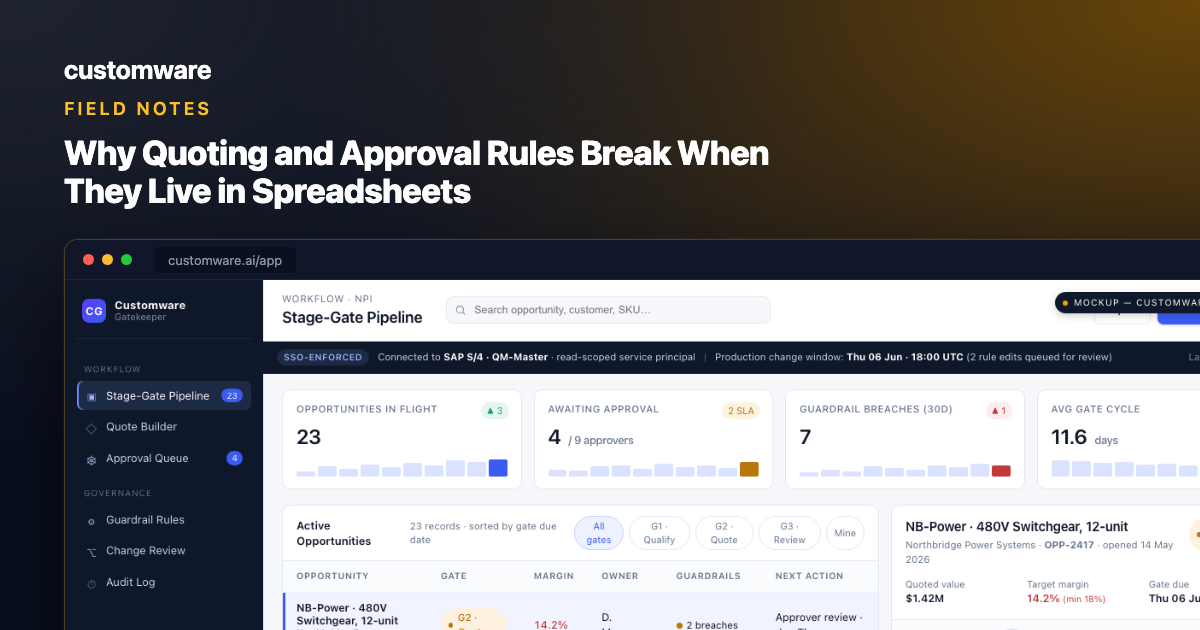
Quoting guardrails trapped in spreadsheets create risk you can't audit. Here's what a trusted, IT-approved stage-gate system looks like for manufacturers.
The commercial leader at a mid-market manufacturer knows every quoting rule cold. The margin thresholds, the approval tiers, the product-specific guardrails — refined over years of deal-making. The problem: they also live in a dozen spreadsheets, a few SharePoint folders, and the heads of two or three people who've been around long enough to know the exceptions.
That's not a process. That's institutional knowledge in a fragile container. And when a new product opportunity needs to clear a stage gate, the decision is only as reliable as whoever pulls the right file today.
The rules are right. The container is wrong.
When a quoting guardrail lives in a spreadsheet, it isn't actually enforced — it's referenced. Someone has to know to look, know which tab applies, and manually apply the logic. Same for approval thresholds: a margin rule that lives in a cell is not the same as a margin rule that fires automatically at the right moment in the right stage.
Generic tools — whether spreadsheets, shared drives, or general-purpose AI assistants — can help an experienced operator work faster. They don't encode the decision chain. As one commercial team described it: "The business rules live largely in experienced people's heads and in scattered spreadsheets — exceptions, thresholds, product assumptions, handoffs." That's a description of a process that scales with the person, not the system.
When someone leaves, takes a vacation, or just has a busy week, the guardrail gaps show up — and they don't always announce themselves.
The prototype trap
Builders can stand up a screen quickly now. A prototype with a clean UI and the right fields is impressive in a demo. But for a revenue-critical, multi-gate approval process, the questions that matter aren't on the screen:
- Who can change an approval rule — and who reviews that change before it reaches production?
- How does the system know what stage an opportunity is in and which guardrails apply?
- What does the data access model look like, and can IT review it before sign-off?
"A demo doesn't answer 'who can change what,' 'how is quality assured,' or 'how do we review a change before it hits production.'" That gap is why promising prototypes stall.
A prototype shows possibility. It doesn't answer the trust questions a regulated environment has to answer before a commercial team will rely on a system that holds real deal data. In a Microsoft- and SAP-centric environment, those questions aren't bureaucratic friction — they're prerequisites. Building without them means seeking IT approval after the fact, which is a different and much harder conversation.
The hidden risk: connected rules that break silently
Here's the deeper structural problem. "The quote and the gate decision are not isolated artifacts — they are the OUTPUT of a larger, connected process." What stage a deal is in determines which margin rules apply. Which margin rules apply determines who has to approve. Who approves determines what data they need to see.
If the system handling approvals doesn't understand that chain, a quote or a gate decision can look correct while actually being wrong — the logic is right for a different stage, the threshold used is the old one, or the approval route doesn't reflect a rule change made two quarters ago.
"Change risk is the hidden blocker: in a connected approval process, improving one rule can silently break another without context awareness." Generic tools can't protect against this because they don't hold the context of why a rule exists or what it connects to. You get the appearance of a system while still operating on informal logic.
What a trust-first build actually looks like
The commercial leader who owns this process doesn't need to become a software project manager. They need to be able to describe how they decide, have that logic encoded in a system IT can review and approve, and be able to change a rule without cascading failures.
That means three things in practice:
Start from the decision chain, not the screen. The business logic — margin thresholds, gate criteria, approval tiers — gets extracted from spreadsheets and from the people who've been carrying it. That logic becomes the foundation of the system, not a feature bolted on after the UI is built.
Treat IT requirements as design inputs, not late-stage hurdles. Access controls, data residency, and audit trails aren't boxes to check after a prototype is working. They're constraints that shape how the system is built from the beginning. A build that starts from both the business rules and the IT constraints simultaneously is the only kind that actually closes the adoption gap.
Build for change with context. Rules evolve. New products enter the pipeline. Approval tiers get adjusted. A system that understands why a rule exists — not just what value it holds — can surface change impacts before they reach production, rather than after a decision has already moved through the wrong gate.
"They are not buying code — they are buying confidence that a connected, revenue- and compliance-sensitive process can be captured, enforced, and trusted." The durable asset isn't the running application. It's the structured, enforceable understanding of how the business decides — documented, reviewable, and able to survive the next personnel change.
If your quoting guardrails and stage-gate approval rules are still living in spreadsheets and experienced heads, we'd be glad to walk through what encoding them into a trusted, IT-approved system actually takes. Book a 30-minute build conversation below.
Ready to fix this in your business?
Customware lets your team build production-grade software around how you actually work — by directing AI agents, not hiring a dev team or a long consulting engagement. Request early access.